
 Numerical Methods for Partial Differential Equations
CS555 :: Spring 2026
- Class Time: Tuesday/Thursday 12:30-1:45pm [Catalog]
- Class Location: 1035 Campus Instructional Facility (CIF)
- Instructor: Paul Fischer
- Office Hours: Tue. 2:15-4:00
- About the Course
- Lectures
- Quizzes
- Homework
- Final Project
 About the Course
Are you interested in the numerical approximation of solutions to partial differential equations? Then this course is for you!
The course covers roughly three topics: the fundamentals of finite difference approximations, an introduction to finite volume schemes, and comprehensive look at finite element methods.
Topics
-
Introduction
- Overview
- FDiff cost examples in 1D/2D/3D
- derivation
- eigenvalues
- error analysis
- Tensor-products
- solvers and eigenvalues
- Cost analysis in d dimensions
-
Timestepping considerations
- Stability/costs
- Survey of timesteppers: EF/EB, Trap/CN, BDFk, RK, exponential
-
Hyperbolic PDEs
- Advection + FDiff: stability/dispersion
- FDiff: equivalent differential equation
- FDiff: upwinding/variable grid spacing
- FVol: conservation/FV methods
- FVol: flux limiters/WENO schemes
- WRTs: finite element methods
- Multiple space dimensions
-
Parabolic PDEs
- Explicit, implicit, semi-implicit
-
Elliptic PDEs
- Poisson FEM in 1D and 2D with tensor products
- Poisson FEM in 2D with triangles
- Stokes FEM in 2D with triangles
-
Special topics
- High-order methods
- Other equations
- Reduced Order Models
 Prerequites
The expectation is that you have had a course in numerical methods (like CS450), covering conditioning, numerical linear algebra, numerical quadrature and differentiation, and the basics of numerical methods for ordinary and differential equations. If you do not have this background, please check with the instructor.
In addition, you should have familiarity with Python or Matlab (or Octave). If you do not have this background, please check with the instructor.
The course will provide practical approaches to generating (highly accurate!) approximate solutions to partial differential equations and will explore mathematical underpinnings that give insight into the behavior (i.e., stability and convergence) of these methods. Basic linear algebra will be an important tool in this course. If you have questions about your mathematical preparation for this course, please check with the instructor.
 Expected work
The course involves several assignments along with midterm and final project presentations based on material developed over the semester. There is also a strong participation grade based on quizzes, handouts, and other in-class tasks. The tentative grade breakdown is:
Work in teams of two for the Homework and Projects.
- Quizzes, in-class work 10
- Homework 30
- Midterm Project 30
- Final Project 30
This will be finalized in the first week of class.
The course assignments and examples in class will be in Matlab/Octave or Python.
 Lectures
| Lecture | Date | Topic | |
|---|---|---|---|
 |
01-20 | About the course, classifying PDEs, survey of methods
|
|
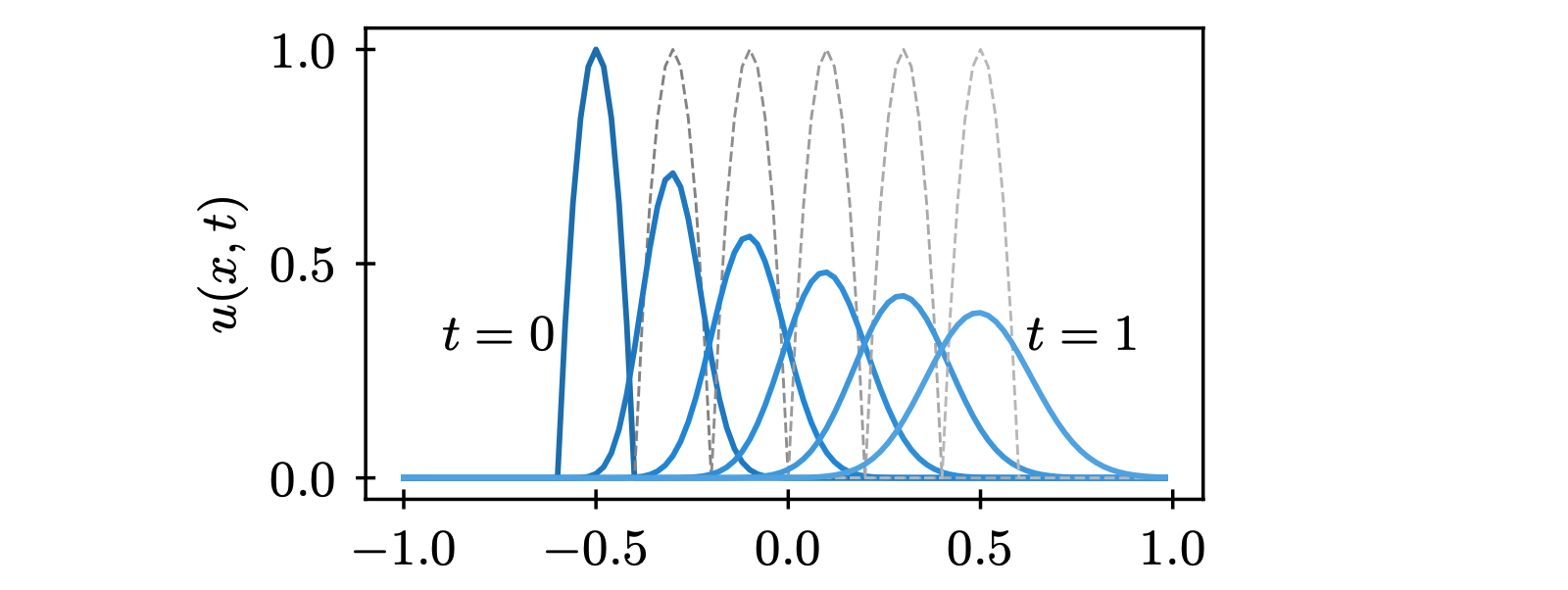 |
01-22 | Finite differencing for time dependent problems
|
|
|
01-27 | Finite differences for parabolic problems in 1D
|
|
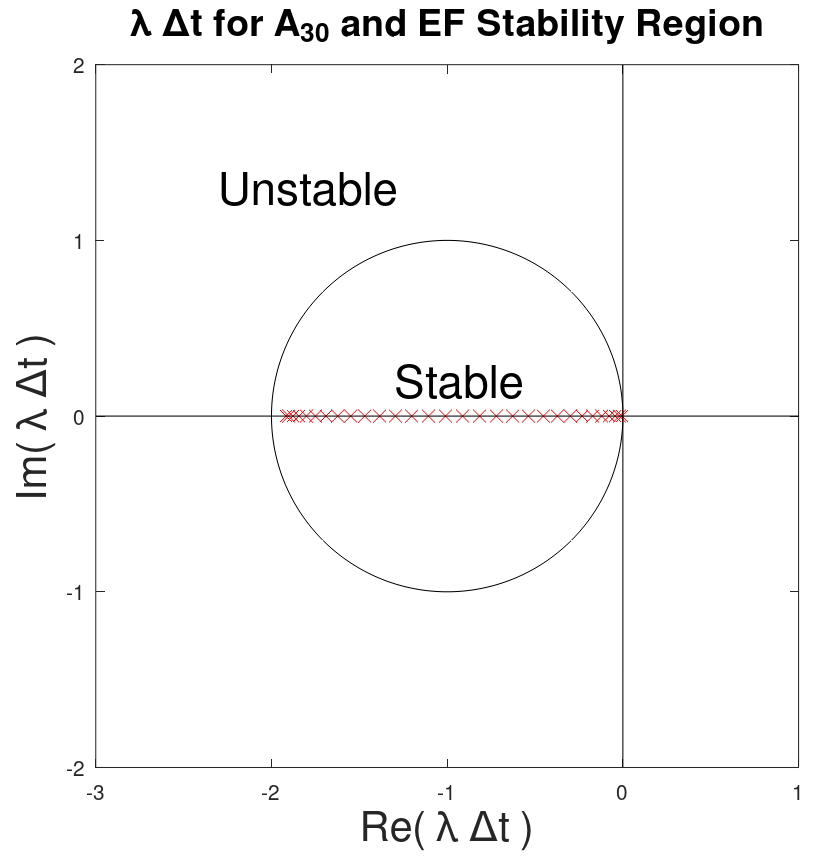 |
01-29 | Intro to Time-steppers for PDEs
|
|
|
02-03 | Time-steppers/Multidimensional Heat Eqn
|
|
|
02-05 | Multidimensional Heat Eqn
|
|
|
02-10 | Kronecker Products/Alternating Direction Implicit | |
|
02-12 | ADI/Var. Spacing
|
|
|
02-17 | One-Way Wave Eqn.
|
|
|
02-19 | Equivalent Differential Eqn. I.
|
|
|
02-24 | Equivalent Differential Eqn. II.
|
|
|
02-26 | Equivalent Differential Eqn. III.
|
|
|
03-03 | CFL and High-Order Finite Differences
|
|
|
03-05 | CFL and High-Order Finite Differences | |
|
03-10 | CFL and High-Order Finite Differences
|
|
|
03-12 | Finite Volumes
|
|
|
03-24 | WENO
|
|
|
03-26 | FEM
|
|
|
04-02 | FEM II
|
|
|
04-07 | FEM III
|
|
|
04-09 | FEM IV
|
|
|
04-14 | FEM
|
|
|
04-16 | FEM
|
|
|
04-21 | FEM
|
|
|
04-23 | FEM
|
|
|
04-28 | Linear Solvers for FEM | |
|
04-30 | Linear Solvers for FEM |
 Quizzes
 Midterm / Final Projects